Between Accessibility and Wastage: How Poor Public Digital Infrastructure Denies UDUS Students of Global Opportunities
When opportunities like Microsoft LinkedIn Premium were shared among students of several universities in Nigeria, what followed is regular feedback. Customary among them are responses such as “Thank you, I have successfully registered,” or “Yes, I have been given access to LinkedIn Premium.”
However, to the students of Usmanu Danfodiyo University, Sokoto (UDUS), registration for such opportunities always feels like a distant hope due to ineffective operation of the institutional mail — a resource connected to students’ success beyond the four walls of classrooms.
Student institutional mail is an official email provided by universities. The email often bears the institution’s domain name and the students’ admission numbers, serving as the academic identity of students. This student mail is recognized by educational platforms, research bodies, and other international institutions as a proof of studentship.
Ordinarily, the student mail is the primary channel through which universities communicate official updates to the students. It also opens the door to scholarships, academic journals, research databases, and other professional platforms.
Despite the significance of this facility, its relevance holds no water among UDUS students. Unawareness of its availability, poor recognition of its benefits, and usage barriers formed a mixed reason that shun Danfodiyo students of life–changing opportunities, sometimes on the global stage.
The Digital Divide
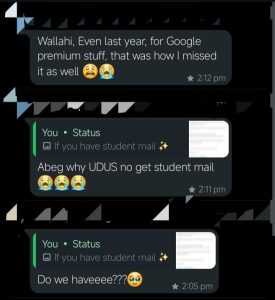
For Abdullah Adekunle, an Optometry student, a term “student mail” was belled to his ears during an attempt to access an academic platform that mandated its submission. For the first time, student mail was brought to his notice when a colleague mentioned it during a submission process for AI’s Student Waiver Program.
“I was furious, looking everywhere to see if I was the one not getting it right that UDUS offers students institutional mail,” Abdullah said very perturbed. “A final-year student showed me his student email, and I realized maybe we the new students are the ones that are not offered one,” he continued.
According to a survey conducted by Gamji Press, Abdullah is not in the shadow alone. Among 114 students across various faculties in UDUS, the data revealed that a significant demography of students remained unaware of the existence of student mail in UDUS varsity.
In the survey, 40% of respondents, ranging between 200 and 300 level, stated they were not aware that UDUS offers student mail. The students claimed they receive academic and institutional updates primarily through informal channels like WhatsApp groups, Facebook groups, campus pressboards, and mostly, word of mouth.
Summaiyah Ojonugwa, a 500-level student, is another student who shared her fateful experience. Despite having spent five academic sessions on the soil of the university, she had no idea that student email existed.
“I never heard anyone talk about it. When I tried verifying my LinkedIn profile, I realized that I could use my school email. But because nobody had told me about it, I assumed the school does not provide it,” she recounted how she gave up on a productive opportunity because of an awareness barrier.
The Activation Barrier
It took three years after gaining admission into the university before Hafiz Sani Galadima, a 400-level Nursing student got access to his student mail. He explained that he did not, at any point before the activation, get to know that UDUS students enjoy the student mail.
From his experience, he concluded that the knowledge and awareness gap made access to institutional mail almost impossible for most students.
“The process was neither automatic nor explained to me at any point since my stay in the university until a friend made that possible.”
While some students, one time or the other, have heard of the student mail, access to the facility does not come without taking tolls on the users.
The survey by GAMJI PRESS confirmed that the inaccessibility to the student mail is prevalent among students who use the new school portal. This set of students fall between 300–level downwards — that is, students admitted from 2022 till the present.
Responding to an inquiry by this reporter, Yusuf AbdulQudus, a student of Islamic Studies who operates the old portal, noted activation of the student mail is not relative to returning students like him who gained admission before the year 2022. However, his stories revealed a systematic error.
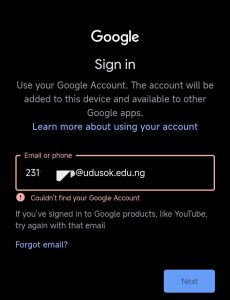
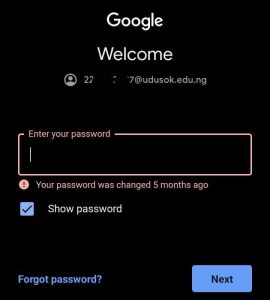
“When I tried to create my student email, I encountered an error message, saying my password had been changed 5 months ago. I was confused.
“I also attempted to log in with my portal password, yet it still did not work.”
Abdullateef Abdullah, a 300 level student of Medical Laboratory Science, explained his ordeal while trying to activate his student mail. His experience reminisced how an explanation without results could end up a futile adventure. The unavailability of his student mail dashed hishope of registering for two different beneficial.
He bemoaned the absence of reliable official communication channels from the school authorities that will guide students on registration and activation process.
“I was only informed verbally by some senior colleagues and there was no clear or official step-by-step procedure.”
“I even tried checking the school portal for guidance on how to get it activated. I reached out to senior colleagues who explained that it is automatically done by the Management Information System (MIS) or Information Communication Technology (ICT) Unit.”
The Lucky Students
According to Zakariya’u Dauda, a recent graduate of UDUS, the benefits of effective running of the student mail are enormous.
As he successfully had access to his student mail, he extensively utilised the opportunity for academic and professional opportunities. Among them are registration on ResearchGate, unlocking free Canva Pro, including many others.
“My student mail has given to me numerous opportunities I would not have access to, with my personal Gmail account,” he said, pointing to the fact that the majority of his friends were unaware of the mail’s existence, while others experienced difficulties accessing it “thereby missing out on various opportunities.”
On the part of Hafiz, his registrations for some academic and global opportunities would have been impossible without the student mail. His concern focused on the fact he would have missed programmes he highly qualified for, simply because he did not have the student mail.
“The mail was used to confirm my studentship status. I also got access to Google premium for all the Google services,” he explained.
“99% of Students Are Not Using It” — UDUS MIS Director
During an interview with GAMJI PRESS, Mallam Riliwanu Mohammed Ladan, the Director of Management and Information System (MIS), commented on the students’ challenges. He disclosed that the school decided to disable the automatic creation of student mail for its students.
While the institutional email address would be automatically created for students in the past, upon confirming them as students, the precedent was halted because 99% of the students failed to take advantage of the opportunity.
Mallam Rilwanu claimed that the above failure of the students often resulted in unnecessary creation of storage on the university’s database. Hence, the need for the school to disable the automatic creation.
“Now, anyone who wants access to their student email must come down to the MIS office for activation,” Mallam Rilwanu remarked.
Although the decision of the university presents a practical solution to prevent unused resources, the same venture has developed a widening gap, cutting students from access to a significant digital resource.
When asked how the school communicates official announcements to students, with the customary and convenient channel in other counterpart universities being student mail, the MIS Director replied, “most official announcements are posted on the university’s primary website where we expect all students to access the latest information.”
“But many students do not even know the university’s main website. They only know the subdomain they use in checking results.”
Missed Opportunities, the Costs
Before a senior colleague could bring Abdullah’s attention to the activation of his student’s mail, it was already too late. He could not successfully register for the Google AI Student Waiver where he craved to enjoy premium services such as latest models, increased number of uploads, audio overview generation, and many more. Why? Because there is a gap between him and his academic mail that period.
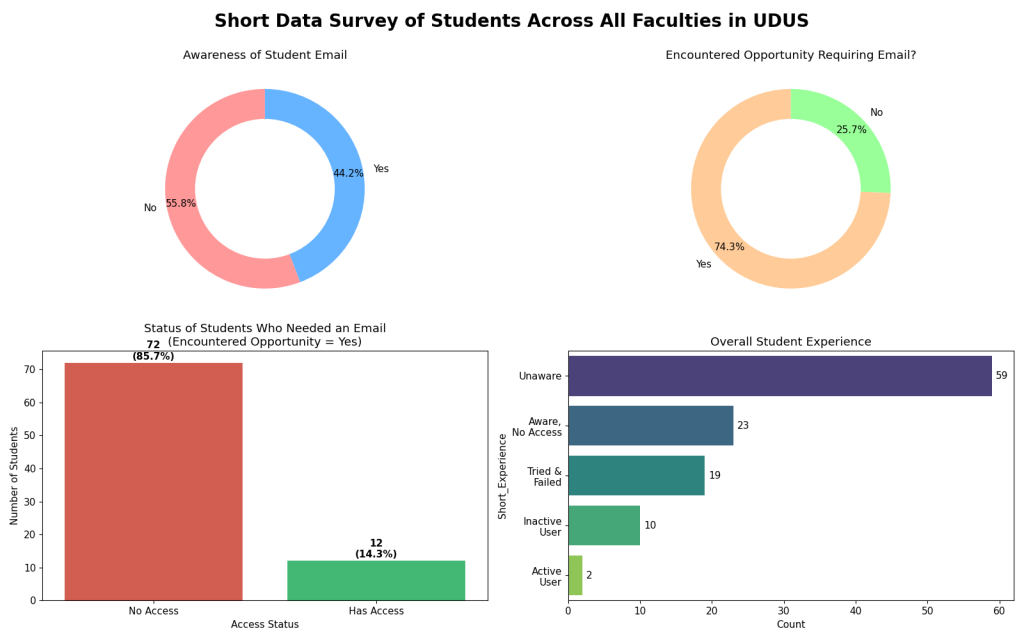
Abdullah’s experience represented 74.3% of the survey correspondents who claimed they have encountered an academic or professional opportunity that requires the student email.
When Salahudeen Mubarak, a student of Arabic Education was selected for the second cohort of AGILE, one of the most competitive international opportunities that saw few selected participants across about 75 countries of the world, the young passionate change–maker nearly saw his long-term efforts put into near waste during the mandatory onboarding session.
The moderator of the onboarding session ordinator directed every participant to join the meeting with their respective students’ mail using Microsoft Team. However, Salahudeen did not have one that time. At that period, his heart started to race steadily until the meeting coordinator dished out his generosity, allowing students without institutional email addresses to use their respective personal mail.
“I would have missed out on the programme, even though I was successfully selected if the coordinator was not lenient enough.”
Meanwhile, Abdulrasheed Aliyah, another Nursing student from the university, was not as lucky as her colleagues. Her anxiety became valid when she lost a qualified opportunity due to absence of institutional mail.
She expressed her disappointment toward the school authorities, “Missing out on opportunities one qualifies for or merits because of absence of student mail comes with a high level of disappointment.”
Aliyaht’s frustration focused on the lingering challenge, as change became out of sight. “Students become less-concerned about engaging in programmes that can fetch them opportunities because they are unsure of being able to apply because of the student mail even if they are eligible.”
“This indirectly breeds unproductivity in students,” she lamented, expecting consequential changes.
A Starking Data

A survey of 113 students from 15 faculties of the university flagged awareness gap as the main source of the students’ woes.
While 55.8% of the respondents were unaware of the existence of the student mail, another 20.4% are aware of its existence but ignorant of the activation process.
Another 16.8% of the correspondents claimed they have tried to access, but all to no avail.
63% of the correspondents are using the school’s new portal (my.udusok.ed.ng), students from 100–level to 300–levels.
Another 8.8% of the students claimed they have access, but rarely use the mail. Among them is Olarinde Sodeeq, a 500–level Pharmacy student. Failure by the school management to communicate official updates through the channel fueled the students’ loss of interest in the resource. The survey showed that none of the students have ever received academic information through the mail.
Only 1.8% of the respondents, representing just two students among the 113 correspondents claimed they have access and actively use the mail.
While interviews with several students established that the academic mail is a passport to students’ success beyond the classrooms, one question has emerged. Why orientation events like matriculation ceremonies, freshers’ fiesta occasions, and other orientation programmes often organised for new students across the university failed to address this important question.
With the school discontinuing the automatic creation of the mail, prioritising awareness action during confirmation or other registration procedures is never a choice.