Inside Story of UDUS Students Promoting Menstrual-Friendly Environments Amid Rising Burden

When Shubiat Musa Aibinu, a 300-level Nursing student, set out for an examination as a first year student in 2023, she did not know she was drawing closer to a looming encounter, an experience that would later change the direction of her academic journey. Shubiat envisaged a usual experience, just like every other good day. Little did she know that a menstrual period that started calmly that fateful morning would eventually set off chains of events that would force her to repeat 100 level and add an extra year to her time on campus.
“When I got to the examination hall, I felt a sharp pain. It was nothing at first, but it intensified later to the extent that I could not walk. I became disoriented and it affected my performance in the examination,” she recalled. “I told Dr. Habibullah before the examination commenced, and he instructed our class representative to help me get drugs or a hot-water compress.”
Although the university authorities recognised her distress, it was not enough to prevent the outcome that preceded the incident.
“I ended up failing the course,” she continued.
The criteria to progress to another level for her course of study only gives students an opportunity of a single failure. However, the third-year student already had an issue with another course at that time, noting that “I repeated the year.”
For Shubiat, menstruation was not merely a monthly visitor. It has become an inconvenience, growing into an academic setback.
Shubiat is not alone. Fatima (second name withheld upon source’s request), another student from the Department of Medical Laboratory Science, recounted a morning she woke up to a familiar pain that shot through her body, a startling reminder of her monthly cycle arrival. However, the arrival of the menstrual cycle coincided with Fatima’s Pathology Continuous Assessment (CA) test.
“It was during the second semester of my 400-level,” Fatima said.
“I was in so much pain that I couldn’t move. I missed the test. When I got better, I met with my lecturer to request a makeup assessment, but it never happened.”
Unlike Shubiat, Fatima managed to pass the course despite missing the marks attached to the test.
The students’ experiences represented the burden of many female students across Nigerian tertiary institutions whose academic journeys are disrupted not by poor preparation or lack of commitment, but by something as natural as menstruation. The primary reason the world observes and celebrates Menstrual Hygiene Day.
What May 28 Means to UDUS Students
Every May 28, people around the world celebrate Menstrual Hygiene Day. The day serves as a global call to create a period-friendly world, one where menstruation is accepted as a normal reality of life, free from stigma, where everyone has access to affordable menstrual products and clean sanitation facilities, and where no one is held back simply because they menstruate.
Menstruation is the monthly shedding of the uterine lining, marked by bleeding through the genital tract. For many women, it signifies the transition from girlhood into womanhood.
According to UNICEF, more than 1.8 billion people menstruate worldwide. Out of an estimated global population of 8.3 billion, this represents approximately 21.7 percent of humanity.
Despite these numbers, millions of women and girls still lack access to facilities that make menstruation safe and dignified.
In commemoration of this year’s celebration, students from UDUS Health College, Usmanu Danfodiyo University Teaching Hospital (UDUTH), organised menstrual hygiene outreaches across secondary schools in Sokoto. In addition to safety menstruation awareness, the students supported the teenagers with menstrual materials.
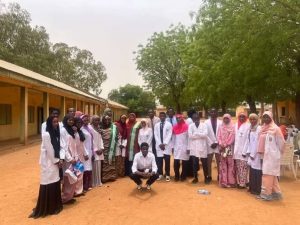
On May 21, students from MBBS visited Nana Girls Secondary School, distributing 180 care packages, including sanitary pads, panties, and detergents. In another event, students from the Department of Medical Laboratory Science visited Yakubu Muazu Secondary School, where they distributed 216 sanitary pads and educated students on menstrual hygiene.
Over the years, such initiatives have become customary among students in tertiary institutions. And students from the reputable “Most Peaceful University in Nigeria” are not considering a second thought to be caught at the centre of the campaign.
A Leaking Neglect
While UDUS students are playing a central role in promoting a period-friendly environment, interviews with multiple sources who spoke to Gamji Press reflected a story of neglect. For a community of students that look after others every year, the emerging question is how far is menstrual-friendly has fared in its own campus.
The challenge is visible within university campuses. Across departments, many restrooms are not adequately equipped to support menstrual hygiene, forcing students to improvise solutions.

“There is no waste bin in our toilet for disposing of pads, so whenever I’m on my period, I come with an extra black nylon bag and dispose of everything when I get home,” said Amina, a 400-level Nursing student, She explained her workaround with a bugged face.
Sometimes, creativity becomes a survival strategy. “The toilet in my department is not clean enough. Since I live with my family in town, whenever I need to change my pad, I leave the department and go to the hostel because it is more comfortable,” said Aisha, a 400-level Pharmacy student.
To confirm the encounter shared with Gamji Press, this reporter visited major restrooms across the campus. During an inspection to the Nursing Department, the toilet had functional doors but lacked running water and waste bins for sanitary pad disposal. The toilet at the Pharmacy Department was locked. As for the restroom near the MBBS auditorium, there’s a waste bin but no running water.
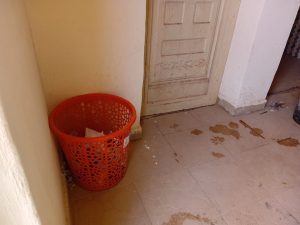
During an interview, Ahmad Abba, the Welfare Director of the Nursing students, maintained that water is available, although he admitted, “that alone is not enough.”
“We have running water. However, we do not have a bin specifically for sanitary pad disposal. Female students are often shy about discussing these issues, so my attention was never drawn to it. We will look into the matter.”
When contacted, Aisha Jiya, the Welfare Directress of Pharmacy students, explained that the restroom had been locked because of a failure in water supply.
“The water system is faulty and cannot reach the toilet. We didn’t want the facility to become messy.”
When asked about an alternative arrangement provided to students during the closure, she admitted that none existed. “We conducted a cost-benefit analysis and concluded that it was better to lock the toilet.”
The welfare director of MBBS, Aisha Dangaladima, shifted blame on the staff in charge for lack of running water. “The pumping machine has been repaired.
“The issue now is that the staff responsible for pumping the water are not always available. We have to keep reminding them, and it can be exhausting.”
The Vice President of the Nigerian Medical Laboratory Science Students’ Association (NIMELSSA), Agbo Victoria Ehi, disclosed that menstrual hygiene extends beyond distributing sanitary products while sharing the efforts of the association to address students’ challenges with poor menstrual experience.
“We provide clean toilets, but there are still no adequate facilities to fully support menstrual hygiene. We are working towards making sanitary pads available in the restrooms.”
She further emphasised that her passion for menstrual-friendly advocacy comes from personal experience.
“I have missed lectures, classes, and laboratory postings because of my period. That experience inspired the outreach. We also left extra pads in the school so girls could have access to them during emergencies.”
Period Poverty: Myth or Reality?
Period poverty refers to the inability to access safe and hygienic menstrual products and the information needed to use them properly. It is often driven by the rising cost of menstrual supplies.
At a local store on campus, a sales attendant, Muhammad Bashar, explained the current market reality. He explained that a small pack containing eight maxi pads and two panty liners costs about ₦800, while the larger pack sells for around ₦2,000.
For some students, these prices represent a significant burden. Faith Adebayo, a 400-level student of Optometry, said, “I have a heavy flow that lasts about six days. The small pack isn’t enough, so I usually need two packs or the larger one.”
Mufida, another source from a family of seven: five girls and two boys, calculated the expenses of menstrual hygiene towards her. She noted that her family spends close to ₦10,000 every month on sanitary pads alone.
The financial burden raised by the two sources are valid. Considering that Nigeria’s minimum wage stands at ₦70,000, menstrual products consume roughly 14 percent of the Mufida’s family monthly income.
For many households, that is not a small expense, it is a recurring necessity. Every year, students organised outreaches, distributed pads, and educated younger girls about menstrual hygiene. Although these efforts deserve an applause, awareness alone is not enough.
Expert Weigh In
While student-led outreaches have increased awareness and provided menstrual products to hundreds of schoolgirls, health experts argue that creating a truly menstrual-friendly campus requires more than annual campaigns. It requires systems that ensure no student has to choose between her education and her menstrual health.
Dr. Amanatullah Odewenu, who is currently on her Obstetrics and Gynaecology posting at the Osun State University Teaching Hospital, Osogbo noted that period poverty extends beyond the inability to purchase sanitary pads. With the rising cost of menstrual products, she said many women and girls are increasingly turning to unsafe alternatives.
“People don’t even consider sanitary pads as an option anymore because of the cost.” she said. “Many now resort to tissue paper, old fabrics and other unhygienic materials.”
According to her, while distributing sanitary pads remains important, universities should focus on creating environments that support menstruating students every day, not just during commemorative events.
“Every toilet, public or otherwise, should be period-friendly. Menstruation itself is exhausting; thinking about where to wash up or dispose of a pad shouldn’t make it more difficult,” she said.
She recommended that campus restrooms be equipped with clean running water, sanitary pad disposal bins and, where feasible, emergency sanitary pads. She also advocated for improved washing facilities, noting that the absence of clean toilets discourages students from changing their menstrual products as often as recommended.
“When students are afraid to use dirty toilets, they keep the same pad on for longer than they should. That exposes them to infections and other health risks.”
Beyond sanitation, Dr. Odewenu believes universities should strengthen their healthcare systems to better support students experiencing severe menstrual conditions such as dysmenorrhoea and endometriosis.
“If you have ever seen someone with severe menstrual cramps or endometriosis, you will understand why some people suggest menstrual leave,” she said. “While that may not be practical in a university setting, schools can provide accessible clinics capable of managing menstrual pain and introduce flexible procedures for students who genuinely miss tests or examinations because of debilitating symptoms.”
She also called for regular menstrual health education programmes to help students prepare for and manage their periods without shame, stressing that such conversations remain necessary even within health-related faculties
Although awareness campaigns have become an annual tradition at UDUS, many believe lasting change will depend on whether menstrual health is incorporated into campus infrastructure, healthcare services and student welfare policies.